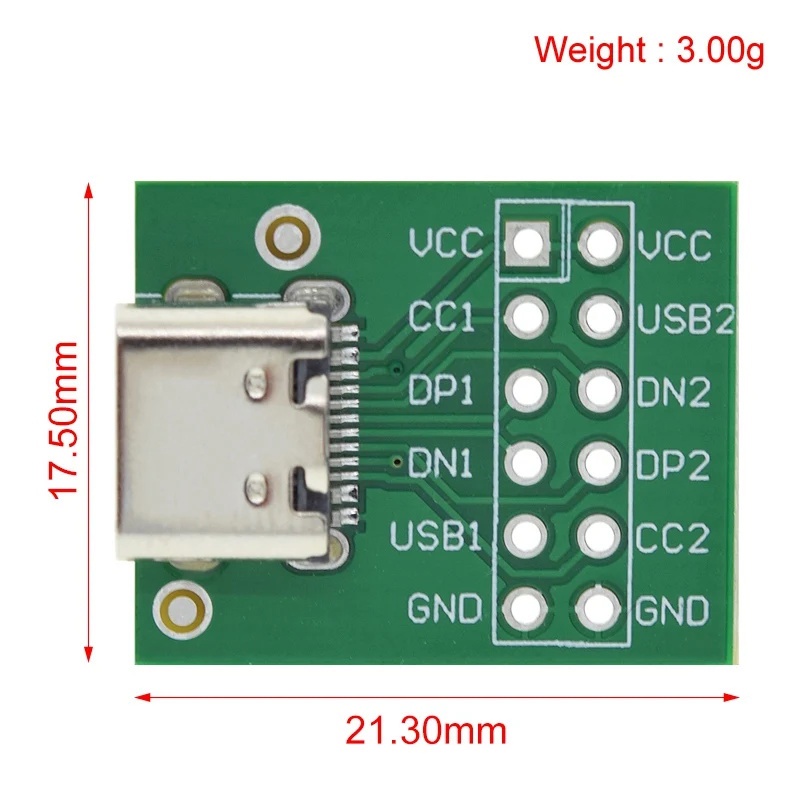
1
🔌 USB Type-C Female Socket Breakout Board (DIP Adapter)
This Type-C USB Adapter Pin is a convenient breakout board designed to give you easy access to all the electrical contacts on a modern USB Type-C female connector. It converts the tiny, surface-mount pins of the Type-C socket into a standard DIP (Dual In-line Package) format, which is perfect for prototyping, testing, and developing new devices.
Stop struggling with tiny connectors! This adapter board allows you to quickly utilize the full power and versatility of USB Type-C in your electronics projects.
✨ Key Features & Benefits
- Easy Prototyping: Converts the complex Type-C connector pins into standard pitch headers, making it breadboard and perfboard friendly.
- Full Pin Access: Provides breakout points for all essential Type-C pins, including VCC, GND, the Differential Pairs (DP/DN), and the critical CC (Configuration Channel) pins.
- Dual-Sided Support: The Type-C socket is reversible, and this board provides access to pins on both sides (DP1/DN1/CC1 and DP2/DN2/CC2) allowing you to develop projects that utilize the full standard.
- Simplified Power Integration: Provides clear access to VCC and GND for quickly powering your project or testing power delivery functions.
- DIP Adapter: The female socket is mounted on a small adapter board, which often comes with unsolderd pin headers, giving you the flexibility to use straight or right-angle pins as needed.
💡 Pinout and Functionality (Standard Type-C)
This adapter is crucial for applications that require communication or power capabilities beyond simple charging:
Pin NameFunctionUse CaseVCC / GNDPower Supply / GroundSupplying 5v power to your prototype circuit.DP1 / DN1D+ / D- Data Lines (Pair 1)High-speed data communication (USB 2.0).DP2 / DN2D+ / D- Data Lines (Pair 2)Alternative data paths for reversible use.CC1 / CC2Configuration ChannelEssential for detecting cable orientation, determining Host/Device roles, and negotiating Power Delivery (PD) functions.SBU1 / SBU2Sideband UseUsed for Alternate Modes (e.g., sending video signals like DisplayPort).
🛠️ Ideal for Development
- Custom USB Devices: Building unique peripherals, keyboards, or sensor hubs.
- Power Delivery Testing: Experimenting with Type-C power negotiation (requires external controller).
- Reverse Engineering: Quickly probing and analyzing signals on a Type-C connection.